AGU
AGU


 Russian
 English
ASU News
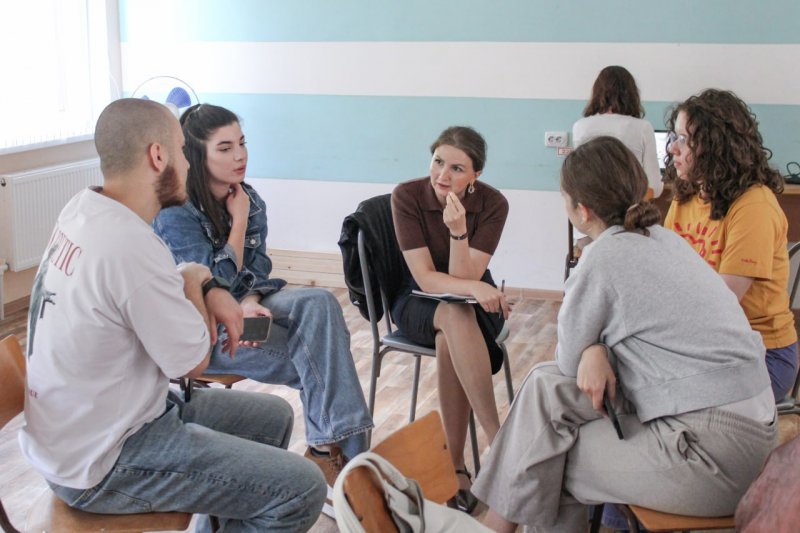
The first Caucasus School on Experimental Research and Cognitive Sciences concluded at Adygea State University's Mountain Legend Center. Held as part of the Priority 2030 program and dedicated to ASU's 85th anniversary, the event was organized by ASU's Experimental Linguistics Laboratory, the Center for Language and Brain, and the Center for Sociocultural and Ethnolinguistic Research at the National Research University Higher School of Economics.
The school brought together over 50 participants—undergraduates, graduate students, and young researchers from across Russia—as well as listeners and speakers from France, Serbia, China, Turkey, Kazakhstan, and Uzbekistan.
The school's key areas of focus included bilingualism, psycho- and neurolinguistics, clinical linguistics, and language policy. Particular attention was paid to experimental methods for studying linguistic diversity in the digital age and their practical application. The school program included lectures and master classes by staff from the Center for Language and Brain and the Center for Sociocultural and Ethnolinguistic Research at HSE University. Their collaboration created a rich educational and research space, bringing together participants from various regions and fields of study.
Olga Dragoy, Director of the HSE Center for Language and Brain, discussed contemporary trends in experimental linguistics, the current work of psycho- and neurolinguistics, and cutting-edge theories that explain how and where in the brain we understand and produce speech.
Understanding the brain's structure and how speech is represented were the focus of lectures by Tatyana Bolgina, a research fellow at the HSE Center for Language and Brain . She discussed classical and contemporary theories of language neurobiology, specifically discussing neural processing at each linguistic level and the mechanisms of reading. Modern understanding of brain organization is based on a network approach. Speech is not organized solely in a single region or a limited set of brain areas, but rather involves a vast network of regions in the left and right hemispheres, as well as white matter pathways.
Olga Buivolova, a research fellow at the Center for Language and Brain, introduced the participants to aphasia, one of the most studied and complex speech disorders. She demonstrated how a linguistic approach allows for more precise classification of aphasia types and the development of individualized therapeutic methods based on these classifications. According to the researcher, the focus of neuroscience today is shifting from descriptive frameworks to standardized, testable tools.
The Center for Language and Brain's research spans all age periods, including childhood. Center research intern Tatyana Eremicheva taught a course on ontolinguistics, focusing on how children acquire language. She outlined four levels of speech development—phonological, lexical, grammatical, and communicative—and discussed how children learn to read as adults. Tatyana emphasized the need for effective diagnostics and flexible approaches to assessing speech skills. The researcher paid special attention to speech development in a context of linguistic diversity.
"The meaning of a statement is influenced by context, the speaker's intentions, and social factors. However, it's impossible to understand the meaning of a given message in a given situation without considering the nonverbal component: the speaker's facial expressions, gestures, and tone of voice indicate how to interpret their message or request. Such information is primarily conveyed through nonverbal channels, " says Yulia Nikolaeva , a research fellow at the HSE Center for Language and Brain .
She discussed nonverbal communication and its role in everyday speech, and also drew attention to persistent myths, such as the widespread idea that "only 7% of information is conveyed verbally." This figure, the researcher explained, is based on distorted interpretations of early psychological experiments and is not supported by modern data.
The Center for Sociocultural and Ethnolinguistic Studies at the HSE Faculty of Humanities also co-organized the school. Its director, Mira Bergelson , and research intern Madina Kade spent five days introducing participants to contemporary sociocultural theories, focusing on research methodology—relying on a wide array of linguistic data and the ability to analyze it.
"An effective analysis of ethnolinguistic situations and the language policy that aligns with them must be based on the interpretation of the researcher's collected data. If we're talking about sociolinguistic interviews, then narrative and discourse analysis methods are essential. This is the only way to uncover the respondents' deepest values, what they truly believe. And everything related to the concept of 'native language' pertains precisely to this ," says Mira Bergelson.
Participants discussed why language cannot be considered outside of its sociocultural context and how this understanding influences approaches to language policy in multiethnic regions.
Concluding the school, Olga Dragoy , Director of the Center for Language and Brain , emphasized the importance of integrating fundamental research into real-world practice, from the participation of neurolinguists in neurosurgical procedures to the use of effective diagnostic tools in schools. She presented some of the center's applied developments: "LexiMeter," a tool for assessing Russian reading skills in primary school children; "KORABLIK," a test for assessing the speech development of children aged 3 to 11; and "Dislektor," a program that uses artificial intelligence to assess the presence and severity of dyslexia in schoolchildren based on eye movement data. Olga Dragoy also discussed the tools developed at the center, which are currently used for intraoperative brain mapping during awake surgeries.
" The applied developments carried out by the Center for Language and Brain are based on three pillars. First, there's a well-thought-out linguistic framework. Second, all our tests meet psychometric criteria, and third, our range of tools is becoming increasingly multilingual every year. We translate and adapt our developments into various languages, and one of the first languages our tools were available in was Adyghe , " she said.
The final event of the school was the satellite conference "Experimental Research and Cognitive Sciences ," which featured speakers from Russia, Europe, and Asia. The conference provided a platform for researchers to discuss how the brain shapes thinking, how artificial intelligence learns from biology, and the challenges facing language in the digital age. The program combined theoretical questions (for example, how cortical activity rhythms develop in infants) with practical cases—from the study of Russian phraseological units to the preservation of the Adyghe language in the diaspora.
"Today, we are studying the characteristics of the Adyghe language and the regional linguistic space, moving into neurolinguistics and clinical linguistics—a rigorous analysis of the connections between brain function and language. The Caucasian School of Experimental Research and Cognitive Sciences is our first experience in this format, and we hope it will become a valuable Caucasian tradition. It opens up new opportunities for linguists: it provides relevant competencies and expands their professional toolkit. I am confident that the School of Experimental Research will become the core of the consortium of universities in Southern Russia, the creation of which we are currently discussing. Interest in the languages of Russia's indigenous peoples fits into both national and global agendas, and the multilingual Caucasus is an optimal platform for experimental linguistics and sociocultural research, " says Susanna Makerova, one of the school's organizers and head of the Experimental Linguistics Laboratory at ASU .