AGU
AGU


 Russian
 English
ASU News
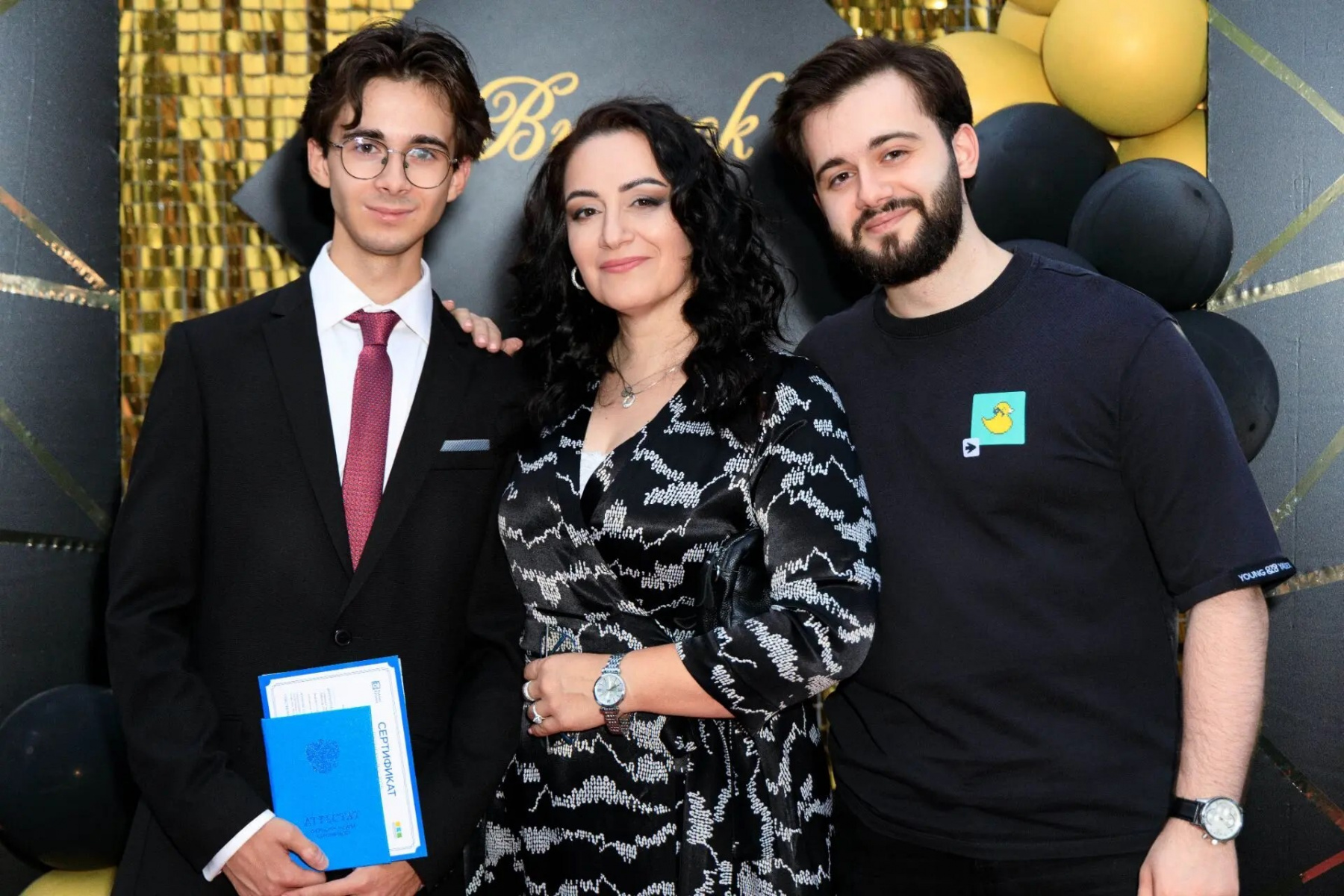
She grew up behind the scenes at the theater, among actors and directors, but devoted herself not to the stage but to foreign languages. Today, Bella Akhidzhak is a PhD candidate in philology and an associate professor in the Department of English Philology at the Faculty of Foreign Languages at Adyghe State University. On Family, Love, and Fidelity Day , she shared what family means to her and how her creative roots have influenced her life's journey.
— Tell us about your childhood.
I was born in Moscow, where my parents studied at GITIS. I spent my early years in a dormitory for creative youth, and later, when my parents returned to their small homeland, Adygea, I spent my childhood behind the scenes at the theater. My parents weren't actors, but their entire professional lives were connected to culture. That's probably why my sister, Ruzanna Akhidzhak, chose a creative profession—today she's an accomplished journalist, a presenter of programs on the VGTRK "Adygea" and at many concert venues, and I'm very proud of her. My sister and I were surrounded by creative people from our family from childhood: among them, Medzhid Akhedzhakov , the first director of the Adygea Theater, and Shaban Akhidzhak , the first director and founder of the U.Kh. Tkhabisimova, Nafset Emtyl , an actress in the Adyghe theater, and my father's colleagues, who often came to our house and organized creative evenings. Thanks to my mother, I graduated from music school, and my sister from art school. So everything around us was conducive to our immersion in a cultural environment.
You grew up in a theatrical environment. How did you end up choosing foreign languages over the stage?
At some point, my father directed my attention to learning languages. He himself dreamed of knowing several languages, and every evening, while discussing various topics, especially world literature, he would talk about how wonderful it would be to read foreign authors in the original. I had a good phonemic ear, languages came easily, and at a family meeting, we decided that after school I would study foreign languages .
— How did you spend your student years?
"My student years were wonderful. We studied hard—language learning requires perseverance and a certain amount of effort—but we also managed to participate in department and university events where we could demonstrate our creative and organizational skills. I have great respect for my dear teachers, with whom we are now colleagues: Nuriyet Yagumova, Aza Tikhonova, Svetlana Sasina, Susanna Bedanokova, Tatyana Ostrovskaya, Safiat Bersirova, and Betty Jandar . The most memorable event of my student years was probably the trip abroad organized by Betty Makhmudovna—we visited the Adyghe diaspora in New Jersey, USA . "
— Tell us about your children.
"Today, my family consists of my children, my mother, my sister, and my beloved nephew. I have two sons: Damir and Temir . They are 24 and 19 years old. The older one chose IT and works at Yandex. The younger one is studying in the Public and Municipal Administration program at KubSAU and simultaneously in the Foreign Languages Department at ASU. I am very proud of them. They have grown up to be smart, kind, and sensitive.
How do you raise your sons? Do you teach them independence or do you always try to be there for them?
"They are very independent. They chose their profession and university themselves; they wanted to become more independent and learn to solve their own problems. I support them in this—they are men, future heads of families. But they know I'm always there. Every child should know that their mother is their "safe haven," a place to which they can always return, gather strength, and sail to other shores. My mother is such a "safe haven."
— Do you have any family traditions?
— Of course. We always get together for New Year's. My mother organizes musical evenings: my sister and I talk about composers, and the children play the piano, violin, and guitar. There's a tradition of having the whole family dinner on Saturdays. These customs come from our grandparents. My maternal grandmother was a "heroine mother"—she had 10 children. All of us—children, grandchildren, great-grandchildren—always gathered at their place, where she would set the table with schipps, pasta, and homemade bread. Watching my nana (grandmother), I learned a lot—most importantly, worldly wisdom, patience, and perseverance.
— Have you worked together with your sister, or do you prefer to separate the professional and personal?
"We haven't had any joint projects yet, but it's worth considering. However, my sister has teaching experience at ASU—she was invited to teach courses in the Philology Department. Students love her, and many stay in touch with her. I also had experience as a presenter at university events as a student."
— Do you think the role of family has changed in the modern world? What does family mean to you?
"Family is the foundation of society and a place of strength for every person. They are loved ones who are always there, supporting and inspiring. This is especially valuable now. Children are an extension of you, and watching them grow and seeing familiar traits in them is an immense joy. I truly hope my sons find their soulmates and create wonderful families. And I wish the same for all young people."
— What would you like to say to your family on this holiday?
- That I love them very much!